Why Tai Chi Is an Antidote for Cortisol
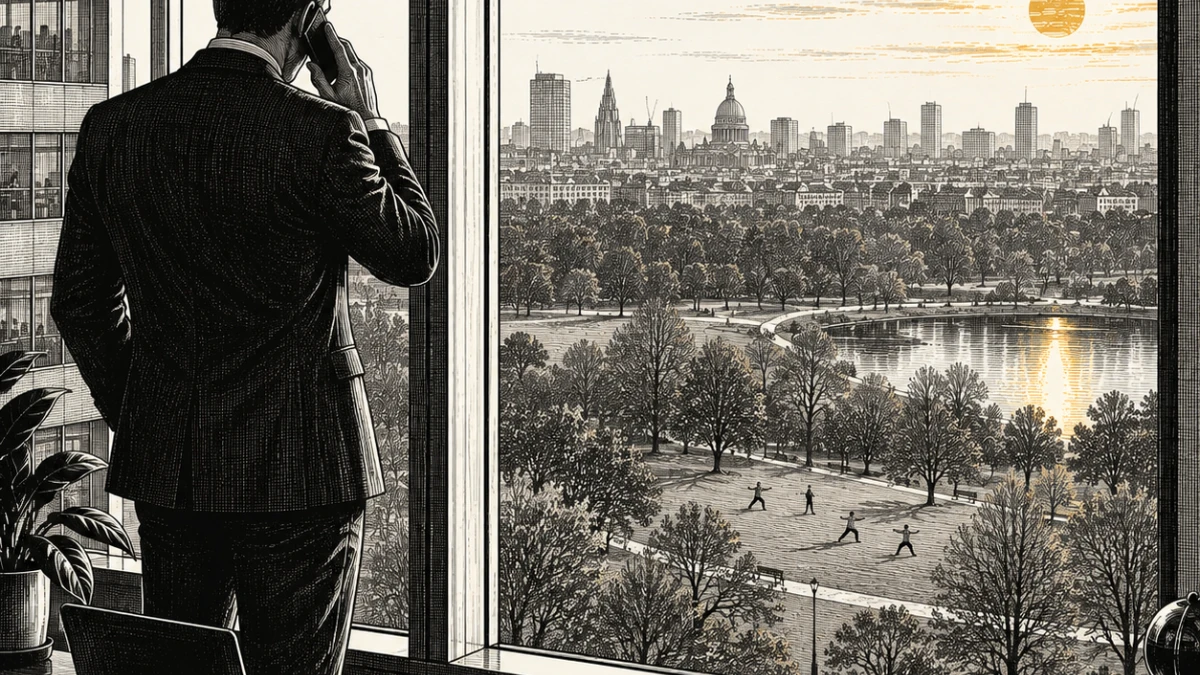
Professional life, whether that is stuck behind a laptop, sat in meetings, or working under pressure, can leaven you with a body and mind that is grinding to a halt under the weight of cortisol. Half of this is the lack of deliberate movement that as bipeds we need. Our whole working existence compounds the impact continuous exposure to cortisol has on our bodies. We evolved to be weight-bearing creatures, movement required to keep our entire system flowing, whether that is musculoskeletal health, gut health (lack of movement drives all sorts of bowel issues), cardiovascular and lung health, and importantly, the systems that switch us between being hypervigilant and relaxed. Movement plays a huge role in resetting cortisol release and letting the system rebalance.
And there is a difference between movement that happens because life requires it to get from A to B and movement that you deliberately choose because you know what it does for you. The first can leave you more depleted than when you started. You can spend a whole day moving around and never really change the state your body is in. You can be standing, walking, lifting, rushing, driving, climbing stairs and still spend most of the day with your jaw clenched and your shoulders somewhere around your ears.
It is the deliberate change of gear that switches off the load you build every day.
I have joked before about moving meetings outside to improve the environment you are trying to perform in, and I am sure you rolled your eyes at that. But I am serious when I say you need to consider some form of deliberate practice to help you regain the bandwidth you need, and continue to build in deliberate cortisol brakes.
This is where I think we sometimes make recovery unnecessarily complicated. We turn it into something that needs a timetable, a membership, specialist clothing and an hour that doesn’t exist. If you are already looking at a week that is packed from beginning to end, another commitment labelled ‘wellbeing’ is hardly going to make you feel more relaxed.
The other side of this is if your working life is high demand, your instinct may be to use exercise in the same way you use everything else: efficiently, intensely and with something to show for it at the end. More distance. More weight. Faster time. More steps. Another box ticked. There is nothing wrong with any of those things in themselves, but they are not necessarily what your body is asking for when the demands have been coming faster than your capacity to recover from them.
For some of you, smashing the squash ball against the wall is a way of releasing tension in a competitive match with a friend or colleague. I used to love sculling 8km every day to release the tension of a 12 hour shift. But when you are already up against time and running an energy deficit, something slower and more deliberate would probably be more effective long term. High-intensity exercise when your system is already dysregulated increases the inflammatory burden rather than reducing it. Controlled, moderate movement reduces cortisol load in people already carrying a heavy load.[1] The body does not need more challenge. It needs the opposite of challenge. This is why I suggest something like tai chi.
Personally, I love watching people practise tai chi. There is something about that slow, deliberate, continuous movement that looks almost like stillness in motion, and that is exactly what it is doing to the system. Every single movement flows into the next, linked to the breath throughout, and to follow the sequence you have to be completely present. Not half here and half in yesterday. Not in the thing you are dreading on Friday. Here, in this movement, in this breath, in this transition from one posture to the next. The what-if loop that has been generating cortisol in the background all day, all week, all year, cannot run at full volume when the mind is occupied with something that demands this depth of focus. The loop needs somewhere to go. Tai chi does not give it anywhere.
That is one of the things I find so interesting about it. There is no opportunity to rush through the movement simply to get to the end of it. The slowness is not an aesthetic choice. It changes what you have to pay attention to. A shift of weight that would normally happen without you noticing becomes the movement. The position of your foot matters. The point at which your heel lifts matters. The turn of your body matters. You cannot really do the form while simultaneously doing three other things in your head. And there is the gentle resistance of holding the positions that leaves you feeling you have exercised and gives you that post-exercise satisfaction and completion.
For someone whose working life is built around anticipation, decision-making and constantly being one step ahead, that can be a rather unusual experience.
Most of the time, being ahead is useful. You need to anticipate the question before it is asked, the problem before it becomes urgent, the deadline before it arrives. The difficulty comes when the same machinery continues when there is nothing immediately in front of you that needs solving. Friday’s meeting gets rehearsed on Wednesday. The conversation from yesterday gets replayed on Thursday. The email you haven’t received yet has already been answered in your head.
Tai chi disrupts the merry-go-round of always having the next thing to deal with by giving you something much more immediate to work with that has a beginning and a conclusive end. A flow that asks, you deliver, and the cycle ends as you finish the stance.
But it is even more than that.
The weight moves from foot to foot throughout the entire practice, constantly, with every transition, and that movement is the vestibular system being gently and repeatedly asked to find its centre. Chronic cortisol disrupts that system: the unsteadiness, the disconnection, the sense of being a passenger in your own body rather than the one driving it.[2] Tai chi deals with that directly, not by force, not by drill, but by the patient repetition of finding centre, losing it slightly, and finding it again, over and over, until the body stops feeling like a thing that keeps failing you and starts feeling like something that can be trusted to know where it is.
And the interesting thing about finding centre is that it is never a one-off achievement. You don’t find the perfect position and stay there. You move away from it and correct. Tiny adjustments happen constantly. Too far one way, come back. Too far the other, come back. The body is continually gathering information and responding to it.
That is a very different experience from trying to hold yourself rigidly in place. It asks for curiosity: you being curious about the physical sensations of moving through space and reacting to them. It asks for motivation to move and hold, to meet the stance rewarding you as you finish. This is so important for telling the threat system that it can stand down. It also helps to kick start the systems that give context to your internal analysis of the world, switching off the cascade that is overloading your system with cortisol release.
Physically, you shift from dysfunctional breathing as the practice demands that your breath throughout is slow and regulated, timed to the movement, and as the form deepens the breathing deepens with it, the diaphragm finally doing the work it was designed to do instead of the shallow upper chest pattern the body locks into under chronic demand. The heart finds a more settled rhythm. The nervous system begins to come off high alert.
There is also something about pairing breath with movement that makes it difficult to fake. You cannot really be thinking about slowing your breathing while continuing to breathe in the same old pattern. The movement gives the breath a rhythm, and the breath gives the movement a rhythm. They start to belong to the same thing.
And as the weeks pass and the sequence becomes more familiar, something else happens that matters enormously for someone whose cortisol load has been slowly dismantling their confidence in themselves. They are building something, finding a rhythm and flow, mastering something precise and controlled, week by week, in a body and a life that has felt out of control for a very long time. That has its own medicine. The internal pressure cooker has filled over the years with a sense of helplessness, among other things. Tai chi is one of the practices that quietly, measurably, begins to work against that.[3]
I think all this is easily overlooked because we tend to talk about exercise in terms of what it does to the body: strength, flexibility, balance, cardiovascular fitness. But there is something rather different about becoming familiar with a sequence and gradually realising that your body can do something you couldn’t do when you first started.
There is no deadline attached to it. Nobody is waiting for you to become proficient by Friday. You repeat the same movements and they become less foreign. Your feet know where to go. Your weight transfers more easily. The transitions become smoother. What initially required concentration eventually becomes something your body recognises.
That can be particularly useful when so much of your professional life is measured in outcomes. Tai chi gives you a process where the repetition itself is the work.
And for those who worry about needing to be flexible, or coordinated, or young enough, or fit enough, tai chi is one of the few practices that has been studied specifically in older adults, in people with chronic pain, in people with anxiety disorders, in people who have been largely sedentary for years, and the results hold across all of those groups. There is no upper or lower age, and like yoga, it does not matter whether you are a beginner or a seasoned practitioner.
And you don’t need a class to do it. It can be something you build into your day without another appointment, another journey or another piece of kit. A few minutes in the morning, at lunchtime after that tedious meeting, or in the evening when you need to wind down. It is there when you need it. That being said, practicing with other people has its own benefits. There is something about that shared rhythm that you don’t get practising alone.
Stand with your feet about hip-width apart, knees soft. Move your weight slowly onto one foot until the other is barely holding anything, then slowly back. Ten breaths. Then hold, weight mostly on one leg, for ten slow breaths more. That’s the whole of it, for a start.
You already know what it feels like when your own body seems like something you are a passenger in, rather than the one driving it. What would it take to notice, even once this week, your feet finding their centre again?
If this made sense then Why board meetings spike your cortisol could be worth a read too. That one is about what a single meeting can cost before you’ve said a word.